 Blueshift
 liquidity portfolios use token weights to shape deposit costs
Blueshift liquidity portfolios accept deposits that buy a share of the whole portfolio, while token weights influence deposit price impact. Compare each selected token’s current portfolio share with its target weight, then assess the amount you intend to contribute. A token below its target can offer room for a deposit without imbalance-related price impact. That room has a size limit, and the resulting LP tokens represent exposure to the portfolio’s changing assets.
An underweight token can offer room for a deposit, but the amount determines whether the contribution stays within that room.
A deposit quote that still matches the plan
For a planned single-token deposit, start with an accepted portfolio token already available in your wallet. Compare its current share with its target and obtain a quote for the intended amount.
An acceptable contribution
Suppose the token sits below its target weight and the quoted contribution shows no deposit price impact. Before authorizing the deposit, use this short checklist:
- The selected portfolio contains the token you intend to contribute.
- Your available token balance covers the quoted contribution.
- The quote for the full amount meets your deposit-cost limit.
- The portfolio’s other assets match the exposure you intend to acquire.
Token access authorization, where required, precedes the deposit transaction. A completed contribution produces portfolio LP tokens; the resulting LP balance provides evidence of the acquired share.
A changed quote before submission
If the refreshed quote shows price impact where none appeared earlier, pause before authorizing the deposit. Other activity may have changed the portfolio balances. Reduce the proposed contribution and request another quote. Continue only if its terms meet the same cost limit; otherwise, stop this deposit attempt. The earlier quote does not establish how much room remains, and waiting alone does not restore it.
Weight gaps and deposit size
A token’s current weight describes its share of portfolio value, rather than its share of the token count. Compare values using a common denomination.
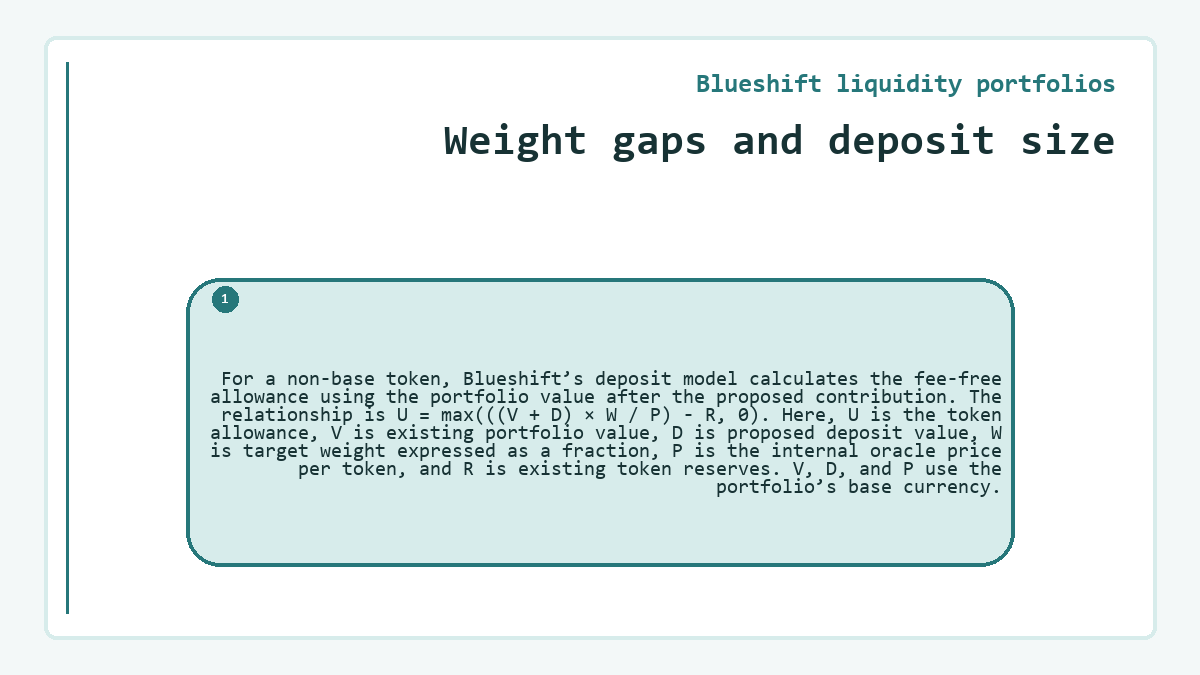
For a non-base token, Blueshift’s deposit model calculates the fee-free allowance using the portfolio value after the proposed contribution. The relationship is U = max(((V + D) × W / P) - R, 0). Here, U is the token allowance, V is existing portfolio value, D is proposed deposit value, W is target weight expressed as a fraction, P is the internal oracle price per token, and R is existing token reserves. V, D, and P use the portfolio’s base currency.
This makes the allowance amount-dependent. An underweight label alone cannot establish the treatment of an entire contribution. The deposit model swaps any excess non-base token amount into the base token, charging a swap fee and adjusting prices before calculating the LP output.
Portfolio ownership after a single-token deposit
Choosing an input token determines what you contribute. The liquidity provider (LP) tokens you receive represent a share of the portfolio, including assets you did not deposit. Holders also earn a share of swap fees.
Swaps change the underlying token balances over time. Consequently, holding the LP position differs from retaining the original token in a wallet. Evaluate the full asset composition before choosing a deposit merely because its quoted price impact looks favorable. A low entry cost does not resolve whether the resulting exposure suits the intended holding.
Do deposits need to match every target weight?
Deposits do not need to contain every portfolio token: Blueshift supports single-token contributions and combinations of accepted tokens. Their effect on portfolio balance determines the relevant trade-off.
One token below its target
A single-token contribution can help fill a shortfall without requiring the depositor to assemble the entire basket. The useful amount depends on the portfolio’s existing balance and the proposed contribution. Increasing that amount can change the quote even while the same token remains selected.
Several accepted tokens
A combination gives the deposit allocator more inputs to work with. It can distribute the requested value across selected tokens within available balances while seeking lower losses. Adding another token only helps if its balance and portfolio position permit a better allocation. Selecting more assets does not automatically produce a cheaper deposit.
The choice concerns funding convenience and deposit treatment. Both approaches acquire a share of the same selected portfolio.
Portfolio prices behind the LP quote
Blueshift’s deposit model values a non-base token using the lower of its internal oracle price and its exponential moving average. Balances alone therefore do not determine the LP quote.
A rapidly rising token price can exceed the price the deposit calculation uses. Likewise, a wallet’s currency valuation may differ from the portfolio’s valuation. Compare the proposed input with the quoted LP output rather than assuming their displayed currency values must match.
Changing weights before submission
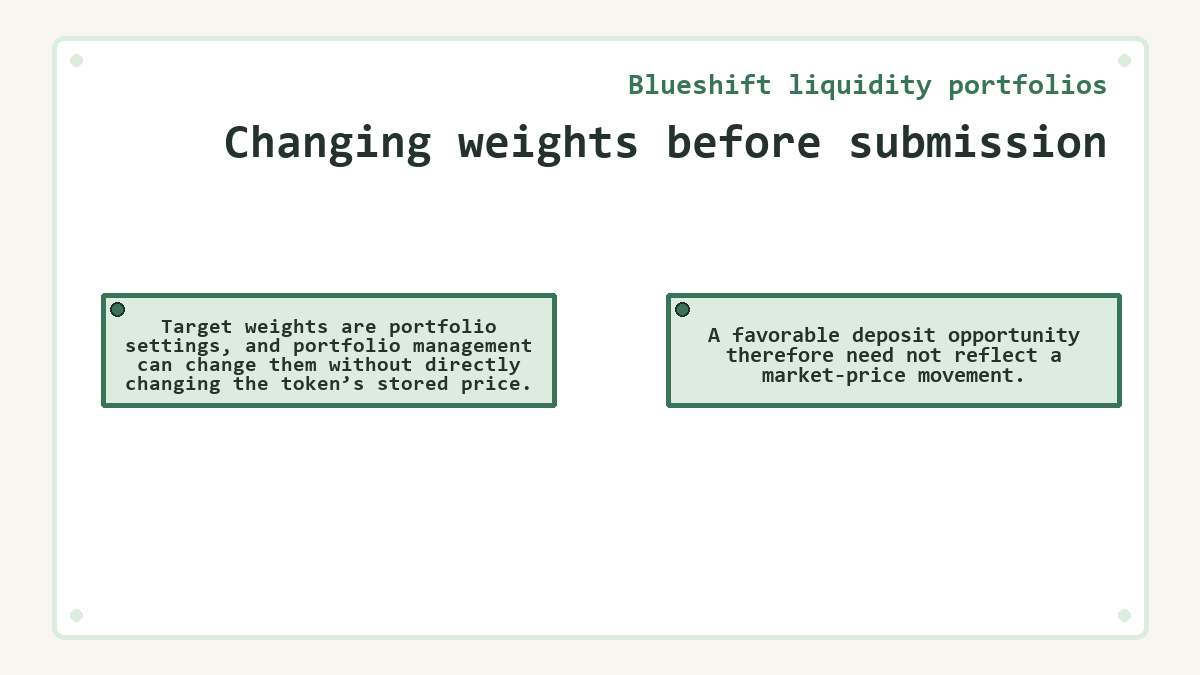
Target weights are portfolio settings, and portfolio management can change them without directly changing the token’s stored price. A favorable deposit opportunity therefore need not reflect a market-price movement.
Raising a token’s target can increase the room available for contributions. Lowering it can reduce that room. Existing reserves and prices still matter, so the direction of a weight change does not establish a deposit amount on its own. Earlier promotional conditions do not establish the terms of a later contribution.
Target weights also describe a desired composition rather than a promise of fixed holdings. Deposit planning uses the settings applicable to the selected portfolio when assessing the contribution.
Why does changing token order leave the deposit unchanged?
Changing token order can leave the allocation unchanged when the lowest-loss distribution depends on wallet balances and portfolio shares rather than your preference order.
The ordering expresses which selected token you would prefer to contribute more of. It does not override the allocator’s constraints. Repeatedly moving the same tokens therefore need not change the suggested amounts. A different total contribution or selection changes the inputs; rearranging an otherwise constrained selection may leave the answer intact.
Exit requirements before choosing a portfolio
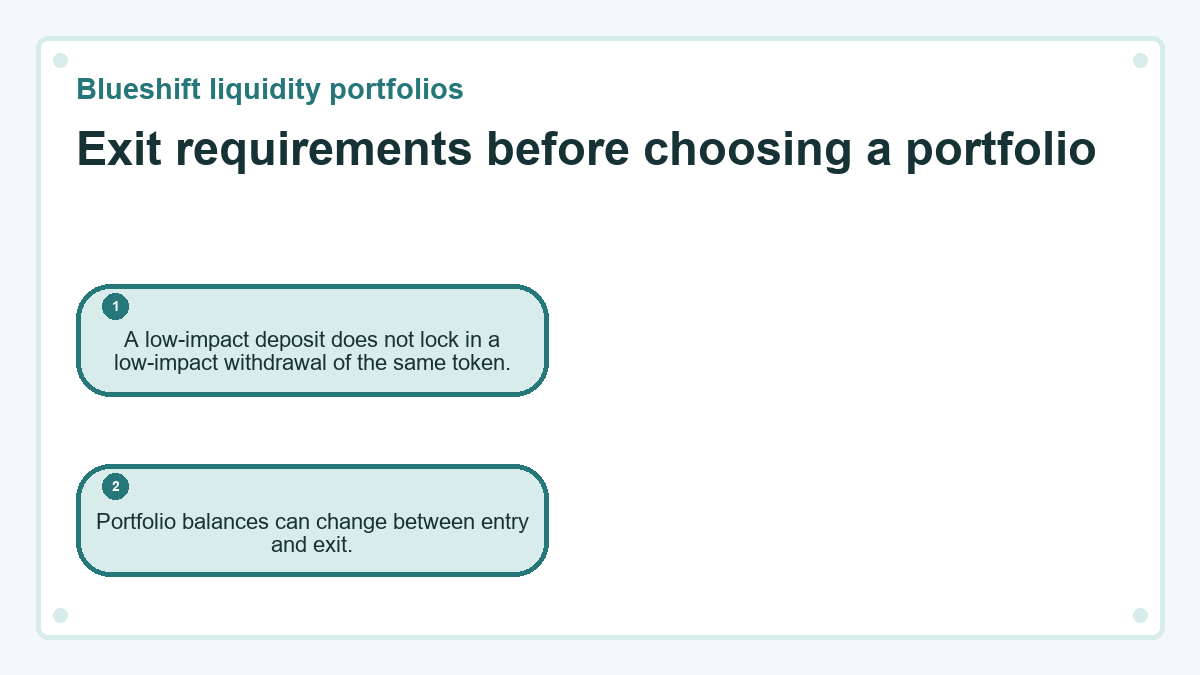
A low-impact deposit does not lock in a low-impact withdrawal of the same token. Portfolio balances can change between entry and exit.
When a token becomes scarce relative to its target, withdrawing that token can create price impact. Another portfolio asset may offer more favorable withdrawal terms. This matters when the intended use of the funds requires a particular token later: accepting portfolio exposure also means accepting that the original deposit asset may become a less favorable exit choice.
Compare portfolios containing the intended input by their full composition and deposit terms, then consider the assets an eventual withdrawal could return. A portfolio’s advertised return does not answer that question. Choose whether to acquire the basket at the quoted entry cost or retain the input token for its intended use.
Quick answers about Blueshift liquidity portfolios
Does the deposit allocator buy tokens missing from my wallet?
The deposit allocator distributes a contribution across selected tokens; it does not make missing wallet balances available. Turning off the balance restriction displays the amounts a lower-impact allocation would require. Treat those amounts as funding requirements, rather than tokens the allocator has acquired for the deposit.
What does a portfolio’s base currency mean for deposit planning?
The base currency is a token within the portfolio used to express the prices of its other tokens. It provides a common valuation unit for comparing reserves, contributions, and target weights. A currency denomination in the interface does not mean the portfolio contains only that asset.
Is a deposit without price impact protected from later losses?
A deposit without price impact still acquires exposure to the portfolio’s assets. Their prices and relative holdings can change after entry, affecting the position’s value. The deposit quote describes entry conditions; it does not fix the later value of the LP tokens or the assets available on withdrawal.
When does farming become relevant to a portfolio deposit?
Farming becomes a separate decision after the deposit creates LP tokens. Where a corresponding farm is available, staking those LP tokens can earn additional rewards under that farm’s terms. Farming rewards do not change the token weights or deposit price impact used to assess the original contribution.
Should I compare LP token counts across different Blueshift portfolios?
Raw LP token counts do not provide a meaningful comparison between different portfolios. Each token represents a share of its own portfolio, with its own assets and valuation. Compare the contribution value, quoted position value, deposit costs, and underlying exposure rather than favoring the quote with more LP tokens.
Last updated -